



CX 2026 Registration
CX Executive Board
CX 2026 Programme
CX 2026 – The 48th Charing Cross Symposium
The Charing Cross (CX) Symposium continues to set the standard in vascular and endovascular education, shaping the future of practice worldwide. CX 2026 marked the final chapter of our current three-year cycle, designed to spark debate on the biggest controversies in the field. Our distinguished faculty of global experts critically examined the evidence, exchanged perspectives, and worked towards building consensus on the issues that matter most.
Consensus was the defining theme for CX 2026. We welcomed an international community of specialists, educators, and innovators to tackle the pressing challenges in vascular and endovascular medicine—challenges that directly impact patient outcomes and clinical decision-making.
In 2024, CX found a new home at ExCeL London, unlocking fresh opportunities for immersive, hands-on learning. The expanded workshop programme has gone from strength to strength, offering delegates practical skills alongside groundbreaking evidence and innovation. In 2026, we returned once again to London’s premier conference and exhibition venue to deliver an agenda packed with cutting-edge science, expert debate, and future-shaping education.
Stay connected—sign up for the CX Newsletter and be the first to hear the latest updates.
CX Co-Chairs


Latest CX news
Live from CX 34: Early results of fenestrated endovascular repair in the UK
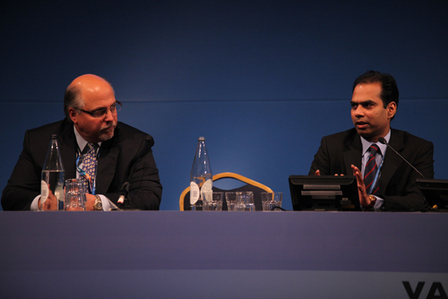
Rao Vallabhaneni, Liverpool, UK, presented data from the BSET study. He told CX delegates the study set out to investigate what the magnitude of early benefit from the procedure was (for instance, a decrease in death); measure how long this lasts and what the target vessel patency is.
The study included all fenestrated EVAR procedures done between 2007 and 2010. Data were included from centres that have done more than 10 procedures and branched EVAR cases were not included. Data were collected online, Vallabhaneni said.
“Three hundred and eighteen patients (of which two were unsuccessful) were treated. The mean age was 74 years (47–86). The mean aneurysm size was 65mm (46–113). Cook stent grafts were used in all cases,” he said.
The analysis showed that combined in-hospital and 30-day mortality was 4.1%. There was approximately a 7% absolute risk reduction, he noted. “The complexity of the case was not related to the risk of death; the target vessel patency was acceptable, as serious consequences of target vessel loss is rare and the broad application appears justified,” Vallabhaneni said.
Live from CX 34: Fenestrated and branched EVAR are worthwhile, majority of CX audience votes
On Tuesday, Krassi Ivancev, London, UK, persuaded 62% of the CX audience to support the motion that fenestrated and branched EVAR are worthwhile. In opposing the motion, Jean-Pierre Becquemin, Creteil, France, garnered the remainder (32%).
He told delegates it was important to clarify the terminology: fenestrated stent grafts were used in juxtarenal abdominal aortic aneurysms or pararenal abdominal aortic aneurysms; fenestrated or branched stent grafts were used in suprarenal or thoracic abdominal aortic aneurysms (type IV); and branched stent grafts are used in thoracoabdominal aortic aneurysms. Ivancev said the results of open repair in such aneurysms were associated with a high mortality rate.
Ivancev based his argument on the fact that the results for open surgical repair were unlikely to improve, and that EVAR was a proven concept. “Fenestrated and branched stent grafts results are equal or superior to the results with open repair,” he said.
He admitted that there was not much long-term data for fenestrated and branched EVAR, but emphasised that the mortality from the procedure was nowhere near that of open repair.
“Patients who are unfit for open repair have been treated successfully. Cost-effectiveness of the procedures, comes with skills, the more you learn to do the better you do it,” he said.
Becquemin noted that fenestrated and branched grafts were like “haute couture, very beautiful, but very expensive”.
He told delegates that in order to be considered worthwhile, fenestrated and branched endografts needed to beapplicable to the majority of patients and that patients had to have no other alternative techniques available to them. “Fenestrated and branched grafts should have a reduced mortality and morbidity compared to open surgery, have proven long-term efficiency and be cost-effective. However, none of these prerequisites are fulfilled,” he said.
While he conceded that the mortality with fenestrated and branched endografts was low, he noted that they were associated with a fairly high rate of paraplegia and re-interventions. “There are no data so far to show any proven long-term benefit of fenestrated and branched EVAR,” he said.
Multilayer stent not a breakthrough, say 56% of CX audience
On Monday, CX delegates heard early data on the multilayer stent. In the discussion it became apparent that MARS requires firm thrombosis in the multilayers and flow to occur into the branches. The indicator of success is the reduction of sac diameter and the consensus was not to use the device in ruptured aneurysms. It became clear that the many experts cautioned not to expect too much of the device and to restrict its use in those high-risk patients where there is no other option.
While flow-diversion was acknowledged as a fascinating concept, the ensuing discussion revealed that there were still questions regarding hard endpoints showing the device’s benefit, bail-out strategies after implantation, and whether this technology was ready to be implanted in patients yet… To the question, “Is the multilayer stent a breakthrough?”, 56% of voters said “no” while 44% said “yes”.
Michel Henry, Nancy, France, told CX delegates that the Multilayer flow modulating stent represented an alternative to current devices to treat thoracoabdominal aortic aneurysms and abdominal aortic aneurysms. He explained that the key principles of the multilayer stent are: vortex velocity reduction, flow lamination in the collaterals, flow acceleration, shear stress reduction at the aneurysm neck. The physiological exclusion leads to the branches remaining patent, he said.
In the Moroccan experience, eight thoracoabdominal aortic aneurysms, five abdominal aortic aneurysms and three dissections were treated. Technical success was 100%, on an average between one and four devices were used. Thirty-day outcomes showed that there were no deaths, branch patency was 100% and that there were no neurological complications.
“These are good outcomes if we compare then with current endovascular procedures,” said Henry. “During the follow-up, we observed a progressive sac thrombosis and shrinkage depending on the importance of collaterals. Henry said, “Despite the severity and complexity of the cases we treated, the preliminary clinical results are satisfactory and promising. We did not observe any neurological complications (these are usually to the level of 10-15% of the cases, with current techniques).
The multilayer stent leads to progressive sac thrombosis and shrinkage depending on the importance of collaterals.” Henry told delegates “To have good results, it is important to have a perfect technique of implantation and to avoid endoleaks (type I or III.).” He made the point that the multilayer stent was not to be used for treating ruptured aneurysms or mycotic aneurysms. “Do not oversize the stent by more than 20%,” he said. He also noted that treating any branch stenosis before covering with the device was mandatory. He highlighted the importance of one month of aspirin and clopidogrel therapy, as well as the importance of an early post-operative CT scan to ensure proper device placement.
“While greater experience and larger follow-up are needed, the multilayer stent appears as a breakthrough to treat any aneurysm,” he said,” Henry said.
Charles McCollum, Manchester, UK, explained that to answer the question of how safe it was to cover side branches, his team had looked at data from Italy and France where >300 vital side branches had been covered (brachiocephalic, carotid, subclavian visceral or renal arteries). There had been one early superior mesenteric artery occlusion and onecoeliac axis thrombosis showing the safety of the stent, he said.
“In Manchester, we have implanted 47 stents and covered and they are all patent with no major complications,” he added. The first 12 multilayer stents were implanted by McCollum’s team in iliac or popliteal aneurysm, with follow-up ranging from 4–16 months. “Eleven fully thombosed to stent (median one week) and there were two revisions. All internal iliac arteries remained patent and there was no aneurysm growth. Three aneurysm sacs shrank >4mm,” he said.
“We also did eight compassionate cases and these have not had a good outcome”, noted McCollum. Among these cases, there was one mycotic thoracoabdominal aneurysm (sepsis at five months) and one 10.8cms suprarenal abdominal aortic aneurysm (rupture at two months). “This stent is not a miracle worker.”
He also said “We have developed a protocol to do 40 perirenal or thoracoabdominal aneurysms where the aneurysm involves or is very close to the important vessels either proximally or distally. These patients are not fit for open repair and standard EVAR is not possible, but they still have a life expectancy >12 months.” McCollum said the investigators had been measuring the patent sac diameter and had seen that the peripherals thrombose very quickly to the aneurysm, but that the abdominals were taking longer. “At this stage before we do a proper clinical trial, we have to see that there is no rupture and that the aneurysm begins to shrink, before you could possibly say this technique is successful.”
Thomas Larzon, Örebro, Sweden, who presented the Örebro experience told CX delegates that the multilayer stent approach is not applicable for all types of aneurysms. “Ruptured aneurysms are contraindicated, but the technology might be applicable in a sub-group. There are no hard endpoints that support that it really works, but its use can be justified in compassionate cases,” said Larzon.
Investigators in Örebro began a study in November 2010 and treated 13 patients with aortic aneurysm. All of these were compassionate cases. Seven of these 13 were non-symptomatic and four were symptomatic. There were also two cases of rupture. Eleven of the 13 were thoracoabdominal aneurysms. Six patients had had previous aortic surgery. Follow-up CTA was every third month and investigators recorded overall/aneurysm-related death, aneurysm size, branch vessel patency, thrombus formation, re-intervention and major adverse events.
“Three patients died due to non-aneurysm related causes (two from cardiac infarction and one from unknown causes). However, two other patients clearly died from the aneurysms, one from a ruptured aneurysm and the other had a very rapidly expanding aneurysm (which was probably a mycotic aneursym) and she died two days after the intervention,” Larzon said. In terms of size, the investigators observed that there was no decrease in aneursym size, and that this was over 15-month follow-up period. In fact, two patients had a significant increase in size,” noted Larzon.
“No thrombus was observed in three cases; there was partial thrombus in four cases and total thrombus formation in one case,” he added. Larzon told delegates that in terms of vessel patency, 28/29 of the major branch vessels were patent. A lumbar occlusion was also identified. The team also observed a spinal infarction with paraplegia (at 15 months).