



CX 2026 Registration
CX Executive Board
CX 2026 Programme
CX 2026 – The 48th Charing Cross Symposium
The Charing Cross (CX) Symposium continues to set the standard in vascular and endovascular education, shaping the future of practice worldwide. CX 2026 marked the final chapter of our current three-year cycle, designed to spark debate on the biggest controversies in the field. Our distinguished faculty of global experts critically examined the evidence, exchanged perspectives, and worked towards building consensus on the issues that matter most.
Consensus was the defining theme for CX 2026. We welcomed an international community of specialists, educators, and innovators to tackle the pressing challenges in vascular and endovascular medicine—challenges that directly impact patient outcomes and clinical decision-making.
In 2024, CX found a new home at ExCeL London, unlocking fresh opportunities for immersive, hands-on learning. The expanded workshop programme has gone from strength to strength, offering delegates practical skills alongside groundbreaking evidence and innovation. In 2026, we returned once again to London’s premier conference and exhibition venue to deliver an agenda packed with cutting-edge science, expert debate, and future-shaping education.
Stay connected—sign up for the CX Newsletter and be the first to hear the latest updates.
CX Co-Chairs


Latest CX news
Data evaluating the new Eluvia drug-eluting stent demonstrate 94.4% primary patency rate at nine months

A clinical trial evaluating Eluvia Drug-Eluting Vascular Stent System (Boston Scientific) has met its primary endpoint with more than 94% of the lesions treated remaining open at nine months post implantation. This was accompanied by a target lesion revascularisation rate of less than 4%.
Results from the MAJESTIC trial were presented yesterday by Stefan Müller-Hülsbeck, Flensburg, Germany, at the CX Abstracts Session – Peripheral Arterial. The trial enrolled 57 patients across Europe, Australia and New Zealand with an average lesion length of 70.8mm.
“I have not seen clinical data this impressive for a vascular stent that has to perform in an environment as challenging as the superficial femoral artery,” said Müller-Hülsbeck. “Because of forces created by knee flexion, there is an increased risk of restenosis, but we are seeing little evidence of this in the MAJESTIC trial.”
The nine-month follow-up showed no deaths or amputations.
The Eluvia Stent System is a stent purpose-built for the superficial femoral artery and uses a polymer and paclitaxel combination designed to facilitate a sustained drug release to reduce restenosis. The system is built on the Innova Stent System platform consisting of a self-expanding nitinol stent with a paclitaxel-eluting biostable polymer matrix loaded on a low-profile delivery system. According to Boston Scientific, the stent architecture features a closed-cell design at each end of the stent for more predictable deployment, and an open-cell design along the stent body for improved flexibility, strength and fracture resistance.
The Eluvia Stent System is pending CE mark and is not available for use or sale in the USA.
CX brings peripheral study data to life with live cases
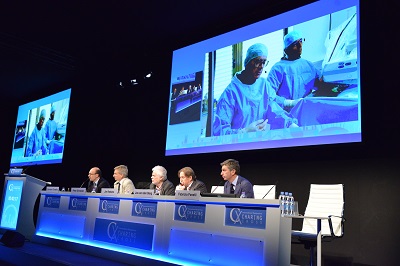
Yesterday, for the first time, the Charing Cross International Symposium broadcast peripheral live cases that were directly linked to data presented the previous day on the theme of peripheral arterial controversies. The aim of the course was to provide delegates with opportunities to learn techniques to achieve the best results with the approaches discussed in the data.
Speaking from Bad Krozingen via satellite video, Thomas Zeller (Bad Krozingen, Germany), the director of the peripheral live cases course, said: “The live case transmissions are little bit different from what people are used to seeing at conferences. Our goal is not to educate or teach you about complex interventions; our goal is to provide you with context to data from recently published trials or even ongoing trials.” He explained that he would be the chief operator in the cases and would be assisted by Alijoscha Rastan, Elias Noory, and Ulrich Beschomer (all from Bad Krozingen, Germany).
The first case of the course was related to the 24-month ILLUMENATE data that were presented on Tuesday at CX by Stephan Duda (Berlin, Germany). It involved a patient who was enrolled in the ILLUMENATE Global Registry, which is evaluating Spectranetic’s Stellarex drug-coated balloon. Zeller explained that the patient appeared to have very mild disease of the distal superficial femoral artery. He added that they had purposely chosen a patient with a “relatively simple lesion” to remind the audience that “almost all of the data you can see so far regarding drug-eluting balloons are TASC A or B lesions”.
Zeller reported that he would be using an 8cm drug-coated balloon (with a 4cm balloon to predilate the vessel) because the rule for using drug-coated balloons should be the same as that for using stents in the coronary arteries: treat from a healthy segment into a healthy segment. He explained that the patient in this case had diffuse disease in proximal areas.
According to Zeller, another rule for using drug-coated balloons was not to put the balloon into the vessel until “everything was prepared”. He said: “Preparation means slashing off the guidewire; it is evacuating cracked air from inside the vessel so that you can see the exact actions of the balloon when it is inflated. If you wait until the balloon is inside the vessel to do the preparation, the balloon is already exposed to the bloodstream; the longer the balloon is exposed to the bloodstream, the more drug you will lose from the surface.”
The second case, in which the Silverhawk atherectomy device (Covidien-Medtronic) and a drug-coated balloon were used to treat a popliteal artery stenosis, was also related to data presented during the peripheral arterial controversies. Zeller commented that the rationale for using atherectomy in this patient was based on the results of the DEFINITIVE AR study, which indicated that directional atherectomy and anti-restenotic therapy (DAART) could be used to improve patency in long and severely calcified lesions: the Zeller himself presented the study’s 24-month results at CX on the peripheral day. However, he commented that the patient in the case was not the typical “DEFINITIVE AR” patient because her femoral artery was “free from disease”. “The popliteal artery, in particular the distal segment, is severely exposed to extra compression forces. Therefore, we usually try to avoid placing a stent in this artery. Thus, we used atherectomy before a drug-coated balloon in this particular patient to try to avoid the need for a stent,” Zeller explained.
Rotational atherectomy, with the Jetstream device (Boston Scientific), and a drug-coated balloon (Ranger, also Boston Scientific) were used, in the third case, to treat a calcified superficial femoral artery lesion. According to Noory, who gave the overview of the case, the first-in-man data for the Ranger device were not yet available but data from the preclinical studies were “promising”. The case sparked a discussion about when to use atherectomy and when to use rotational atherectomy, with Zeller commenting: “Rotational atherectomy is a pretty good tool for occlusions. Also small vessels, 4mm for example, also respond very well to the Jetstream system. If you have larger diameters, 5–6mm vessels, or bifurcations then I prefer to use atherectomy.”
The final case of the morning was supposed to involve the use of the TurboHawk (Covidien-Medtronic) and a drug-coated balloon for the treatment of a lesion in the common femoral artery. This related to the ongoing PESTO-CFA study, which is comparing percutaneous intervention with surgery for the management of common femoral artery lesions. However, Zeller had difficulties putting in the guidewire in the lesion and, after discussing the case with the audience, decided to proceed to putting in the drug-coated balloon without using atherectomy.
In the afternoon, cases were focused on situations in which “stents were unavoidable or beneficial” and “where stents are unavoidable or beneficial and in-stent restenosis treatment”. The devices used in these cases were the Zilver PTX (Cook Medical) with a new release system, the Supera (Abbott Vascular), the Supera with a provisional re-entry device, the Innova stent (Boston Scientific), the SmartFlex (Cordis), a sirolimus-eluting balloon and the BioMimics stent (Biosensors), heparin-bonded contoured-edge Viabahn (Gore Medical), and Rotarex (Straub Medical) and IN.PACT Pacific (Medtronic). During Tuesday’s peripheral programme, there were talks reviewing the current controversies in peripheral stenting.
Giovanni Torsello (Münster, Germany), who chaired the morning session of the live cases course, said the live cases were a valuable educational tool because delegates not only wanted to hear about study data but also see “how they can make their strategies, their techniques better than before. This is why people attend live case courses.”
LINC@CX
LINC (Leipzig Interventional Course) once again held a live case session at CX, which this year focused on below-the-knee interventions. The cases included recanalisation of an infrapopliteal obstruction with a drug-coated balloon, retrograde transpedal recanalisation with 3F access system, and lesion-specific use of a drug-eluting stent and a drug-coated balloon for an infrapopliteal obstruction. Giancarlo Biamino (Mercogliano, Italy) told CX Daily News that live cases that “do not go according to plan” were just as educational as the ones that did because it gave delegates opportunities to see how operator can manage and rectify unexpected situations.
70% say going “off-label” to use EVAR in necks less than 10mm in length can be sensible
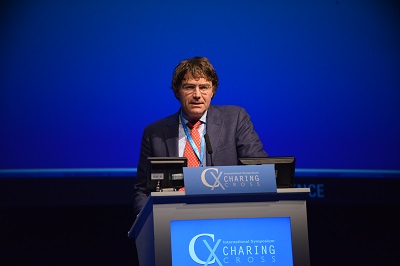
In traditional Charing Cross fashion, yesterday’s debates stirred much discussion in the Main Auditorium. Particularly stirring was the debate where the audience voted 70% against the motion that EVAR is not sensible for any abdominal aortic aneurysm with a neck length less than 10mm. Stephen Cheng (Hong Kong) spoke for the motion, while Jan Blankensteijn (Amsterdam, Netherlands) sounded-off against the motion.
Making his case, Cheng said that even with new devices, there are more early complications, more late complications, more (difficult) secondary interventions and more adjuncts associated with short-neck endovascular aneurysm repair.
On the other hand, his opponent maintained that in selected cases of infrarenal neck length <10mm, “Any of the current infra/transrenal devices can be used with or without endoanchors for enhancement,” adding that even if it comes with a moderately increased risk of type 1a endoleak, it “balances against downsides of F-EVAR, CHIMPS, or against open repair (if F-EVAR is not an option).”
Discussing the outcome of the debate and the audience’s strong position against the motion, Blankensteijn said, “I think that people understand that things are not absolute and clearly we know that staying inside IFU you get better results. I am not running around proposing to treat any less than 10mm neck with an infrarenal device, but the point is that judicious use of these devices outside IFU can produce better results and injudicious use outside the IFU is an instruction that the industry gives you, we need to think with these device what to do an there are several occasions it does not make sense or it may even be dangerous to use a fenestrated stent graft. Then I would suppose that an infrarenal device (for instance Gore Excluder) preserves all the options juxtarenally, so if this fails, you still have the option to use a fenestrated cuff or go higher up.”
The debate took place during a session on procedures for infrarenal abdominal aortic neck.
The answer lies in the neck
While presenting the morphology findings from the IMPROVE trial, Robert Hinchliffe, London, UK, drew attention to independent association between neck length and mortality. “Only aortic neck length is significantly associated (inversely) with 30-day mortality both for open repair (p<0.001) and overall (p=0.007). The shorter the neck, the higher the mortality after open repair (and EVAR). With long necks, the 30-day mortality from EVAR and open repair is similar (and this is consistent with the results of the AJAX and ECAR trials),” he said.
Therefore, added Hinchliffe, a short aneurysm neck was the commonest reason for a patient being unsuitable for conventional EVAR. The results also explain why observational studies, which cherry pick long-necked aneurysms for EVAR leaving all the short necked aneurysms for open repair, always show that mortality is lower after EVAR. “Such observational studies are comparing apples and oranges,” he said.
The morphology findings could also explain the worse outcomes in women as short aneurysm necks are especially common in women.
“In the future, new, widely available endovascular strategies for rupture in short necked aneurysms are needed and results following rupture should report juxta-renal and infra-renal aneurysms separately,” Hinchliffe said.
“Aneurysm morphology indicates whether a patient with ruptured abdominal aortic aneurysm is eligible for EVAR and may influence the outcome of both EVAR and open surgical repair,” he concluded.
Stick to the IFU
Timothy Resch, Malmö, Sweden, enforced the point that the outcome of EVAR is “excellent if we stick to the IFU and hostile sealing zone anatomy affects the outcome of EVAR negatively both in the short and long term regardless of the device that you use.”
Resch explained that 10—20% of EVAR patients have necks <15mm, and these short infrarenal necks are predictive of initial technical failure, with increased incidence of early and late type 1 endoleak and increased use of intraoperative adjunctive procedures, where the long-term outcome is impaired and endoleaks, migration and late rupture are common.
Referring to a contemporary meta-analysis of 12,000 patients treated with modern devices, 3,039 patients with hostile necks saw an increase in 30-day mortality, intraoperative adjuncts, 30-day migration and an increase in type 1 endoleak at 30 days and one year.
Further, in the ANCHOR registry, Resch noted, a regression and ROC analysis was used to try to find predictive factors for type 1a endoleak which showed that the diameter of the neck correlates with poor outcome, as does the anatomic neck length. “This actually provides some solid data for calculating the risk in the individual patient,” he said.
“So one option of course in these short juxta pararenal aneurysms is to seal higher above and use the fenestrated and incorporate the visceral arteries in your repair. Does that solve the problem of the proximal endoleaks? Again, it depends on how you use the graft,” Resch suggested.
Making a case from some of his own data and that of a study at the Cleveland Clinic, USA. “We found no cases with proximal type 1 endoleaks during long-term follow-up of these patients. So maybe this is the solution for everything—using it in the right context. In a larger series from the Cleveland Clinic analysing over 900 patients with fenestrated grafts, indeed there was a 2.8% incidence of late type 1a endoleak occurring in a steady fashion over time and almost half after a year post-operatively. Looking at the risk factor in that series, what they identified again was a poor sealing zone, just as you would in an infrarenal neck and more that 10% was diameter change and they also found that the sealing zone was much more unstable in the juxtarenal vs. more proximal aorta. So from the clinical perspective, we have learned from that and we now place more fenestrations on the graft to reach a healthy sealing zone, which in our series, combined with the series from Lille with 300 patients, resulted in a higher placement of the endograft than we initially did without affecting the operative mortality or the one-year outcome,” he reported.