


Executive Board
Programme
Join the global vascular and endovascular community
Charing Cross (CX) Symposium 2027 returns for its 49th year on 6 – 8 April 2027 at Olympia, London. Come and join us as we welcome the largest international community of clinicians, educators, innovators and industry partners in vascular disease management.
Across three days, CX Symposium will feature a physician-led scientific programme built around lively debate, peer-to-peer exchange, and an audience as expert as those presenting. With 500+ presentations, 300+ discussions, hands-on workshops, podium-first data, live and edited cases and an exhibition, CX Symposium brings together international speakers and the future leaders of vascular care to interrogate the evolving evidence base and its practical implications for best patient outcomes.
Registration opens soon.
CX Co-Chairs

Latest CX news
Live from CX 34: Slim majority do not believe drug elution is worthwhile
In an extremely close vote, 51% of delegates voted against the motion that drug elution is worthwhile for the management of occlusion of the infrainguinal arteries (vs. 49% who voted for the motion).
Supporting the motion were Thomas Zeller (Bad Krozingen, Germany) and Gunnar Tepe (Rosenheim, Germany) and against the motion were Stephan Duda (Berlin, Germany) and Iris Baugmartner (Bern, Switzerland).
Live from CX 34: TASC III – What is achievable?
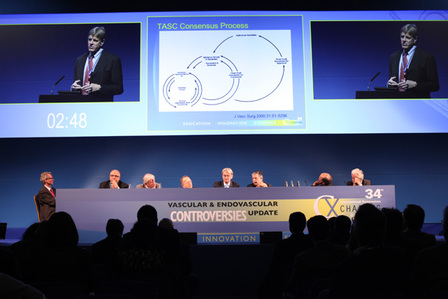
William R Hiatt, Denver, USA, outlined what was achievable with TASC III at CX 34. He said TASC III was seeking to achieve a consensus between surgical and endovascular societies. “The response to TASC IIb was disappointing but current inter-societal engagement encouraging,” he noted.
On the question of whether it was possible to create a more integrated and clinically-relevant classification of peripheral arterial disease, he noted that TASC III would include the key components of: patient, limb and lesions.
He noted that TASC III would establish new standards for regulatory approval and reimbursement of new therapies. For critical limb ischaemia, it would expand on amputation-free survival to include healing of ischaemic ulcers, relief of ischaemic pain, avoidance of additional procedures and improvement in functional status, he said.
Live from CX 34: Endovascular techniques must be taught with interdisciplinary collaboration, 55% of CX delegates say
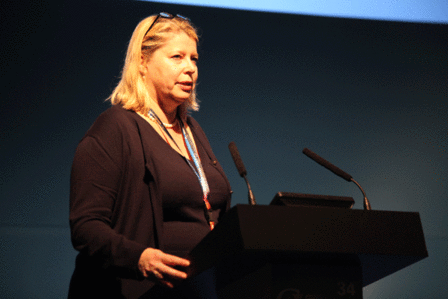
In a close vote, most delegates attending the first debate of CX 34 agreed with Sigrid Nikol, Hamburg, Germany, that endovascular techniques must be taught with interdisciplinary collaboration, with 55% supporting the motion vs. 45% who voted against the motion (and thus agreed with Frank Vermassen, Ghent, Belgium).
Nikol argued that the “excellent” results of endovascular therapy in clinical trials indicate that: “cardiologists, surgeons, radiologists, and other interventionists possessing peripheral vascular interventional skills can perform endovascular therapy safely despite different starting points.” On the other hand, Vermassen argued that training in endovascular techniques can and should be performed in vascular surgery training centres, saying: “Interdisciplinary collaboration is not a prerequisite for training in endovascular techniques.”