CX 2026 Registration

CX 2026 – The 48th Charing Cross Symposium

The Charing Cross (CX) Symposium continues to set the standard in vascular and endovascular education, shaping the future of practice worldwide. CX 2026 marked the final chapter of our current three-year cycle, designed to spark debate on the biggest controversies in the field. Our distinguished faculty of global experts critically examined the evidence, exchanged perspectives, and worked towards building consensus on the issues that matter most.

Consensus was the defining theme for CX 2026. We welcomed an international community of specialists, educators, and innovators to tackle the pressing challenges in vascular and endovascular medicine—challenges that directly impact patient outcomes and clinical decision-making.

In 2024, CX found a new home at ExCeL London, unlocking fresh opportunities for immersive, hands-on learning. The expanded workshop programme has gone from strength to strength, offering delegates practical skills alongside groundbreaking evidence and innovation. In 2026, we returned once again to London’s premier conference and exhibition venue to deliver an agenda packed with cutting-edge science, expert debate, and future-shaping education.

Stay connected—sign up for the CX Newsletter and be the first to hear the latest updates.

CX Co-Chairs

Dittmar Böckler
Dittmar BöcklerHeidelberg, Germany
Andrew Holden
Andrew HoldenAuckland, New Zealand
Erin Murphy
Erin MurphyCharlotte, United States

Latest CX news

Mid-term results for endovenous ablation support shift to office-based vein practice

April 12th, 2011|Comments Off on Mid-term results for endovenous ablation support shift to office-based vein practice

Setting up an office-based vein practice is becoming extremely popular as the treatment of varicose veins is undergoing a revolution. Many physicians feel that it is becoming less and less acceptable for varicose veins to be operated on by using open surgical techniques. 

Three-year results from a recently published prospective, multicentre trial using the VNUS ClosureFast catheter (Covidien) have demonstrated clinical efficacy and improvement in quality of life for patients treated for varicose veins.  Also, laser options are expanding with a new laser system, VenaCure (Angiodynamics) 1470nm laser, being launched at CX33. Recent randomised trials comparing the two modalities with short-term follow-up data have shown comparable results for efficacy.
 
Thomas Proebstle, Mannheim, Germany, presented the three-year results and exclusively told CX Daily News, “We now have solid data to support the statement that the days of cross ligation and stripping are over. We have such high success rates, good durability of results and a gain in quality of life from pre-procedure impairment compared to traditional surgery, that we need to shift to endovenous approaches of treatment.
 
“Obviously this type of treatment does not need to be performed in a theatre or hospital, which improves its cost-effectiveness. It can be performed in a modern office with excellent medical facilities, in an outpatient setting.”

Proebstle said that compared to all of the other current technologies such as laser, foam sclerotherapy and the new kid on the block, superheated steam, ClosureFast is the only one with solid mid-term follow-up. “It is the only one combining the highest efficacy with such a smooth side-effect profile. All the other technologies at the moment lack the proof that they can deliver this smooth side-effect profile, and this needs to be proved in randomised studies,” he said.
 
Shift in principle
 
Proebstle said, “After ClosureFast, the system which delivered high frequency current into the vein wall, there was a subsequent system developed which no longer delivered current to the tissue, but only heated the coil. So from a current-induced heat generated within the tissue, there was a shift in principle to heat conduction only. The catheter here is actually nothing but very expensive single use water heater. With this type of radiofrequency- powered catheter, we observe that pigmentation is a rare event and at three year follow-up, only one out of nearly 300 limbs showed persistent pigmentation.”

He explained that the three-year follow-up results were from a study of patients treated with the ClosureFast catheter at eight European centres. In the study, 295 greater saphenous veins (from 225 patients) were treated. The mean age of the patients was 50.5 + 13.5 years and 73.8% were female. The majority of the patients were CEAP C2 or C3.
 
All the patients were treated in an outpatient setting, under local anaesthesia and the protocol of heat delivery was two treatment cycles immediately below the saphenofemoral junction, and one treatment cycle subsequently thereafter. Combined procedures were allowed only at calf level, but not at the thigh. 
 
“Clinical and duplex examination took place at three days during the first week, at three months, six, 12, 24 and 36 months we had a data retrieval rate of 86–87%, if you refer to patients and limbs treated respectively after three years,” he explained.
 
Proebstle said, “These data include the first-in-man treatment up to the first 295 patients, so this paper actually includes the learning curve for this procedure.
 
Anybody will know that if you have very good results including in the learning curve period, such a technology could be seen as ‘idiot-proof’.”
 
 
Results
 
Proebstle said, “The initial ablation success rate with VNUS Closure Fast is 100%. Only five of 256 (2%) limbs showed axial reflux 36 months after the procedure and as such radiofrequency segmental thermal ablation shows a high efficacy coupled with a very moderate side effect profile. At baseline, 41.1% of limbs were free of pain. At 24 months, 99.3% (n=278) reported no pain, and between12–24 months, 96.4% (n=270) had no pain.”
 
He told delegates that at 36 months, 98.0% (n=251) reported no pain, and between 24 to 36 months, 95.7% (n=245) had no pain.
In addition to clinical efficacy, the study has shown a venous clinical severity score reduction at three-year follow-up. “Overall score improved for 256 legs available at 36 months from 3.9 ± 2.1 at baseline to 0.9 ± 1.1 at 36 months, p
 
The three-year European follow-up of endovenous radiofrequency-powered segmental thermal ablation is scheduled for publication in the Journal of Vascular Surgery in 2011. 
 
 
Questions
 
Responding to a delegate who stated that he frequently saw large veins and asked what the upper limit of the diameters of veins treated in Proebstle’s study was, Proebstle replied, “In this series, the upper limit did not reach the 2cm diameter, but in such cases of large veins you can use this system repetitively. You do not have to adhere to two cycles, you can use three or four cycles for big diameter veins. This is safe, even though it has not been published.”
 
Alun Davies, London, UK, then said “the reality is that you have just convinced us that VNUS is not as straightforward as it is being sold to us. We all use variations in how we treat a segment, so it is no longer a standard treatment. Do you agree with that?”
 
Proebstle replied, “I agree that in situations not covered in the study, in extreme situations with large diameters, there may be a necessity for dose adjustment.”
 
Davies also asked for Proebstle’s thoughts about seeing more pigmentation in severe disease. Proebstle then said that in more severe disease, there was a possibility of an increase seen in the side-effects profile, but clarified that in this study several cases with severe disease were included.
 
Lowell Kabnick, New York, USA, then asked on what basic scientific evidence the proximal two-cycle protocol was based. He said, “My research has shown that there is just a 1mm difference in coagulation zones between one and two cycles. It really has to do with wall thickness rather than the size of the vessel.”
 
However, Proebstle argued that it was to do with the size of the vessel and that this was based on “biophysics, like water running down a hill”.
 
New VenaCure 1470 laser ablation system launched at CX33
 
AngioDynamics has launched a new laser system for endovenous laser ablation of varicose veins at CX33. The new VenaCure 1470nm laser operates at a peak on the water absorption curve. The VenaCure 1470nm laser is a water-specific laser, meaning it damages the intima, or inner most layer of the vein, by targeting water as the chromophore to absorb the laser energy.
 
Since the vein structure is mostly water, this laser is able to efficiently heat the vein with little chance of collateral heating, resulting in an optimal vein ablation.
 
The VenaCure 1470nm laser is designed to work exclusively with AngioDynamics NeverTouch fibre ablation kits, maximising these two technologies and resulting in even better patient outcomes.
 
A company release says that current clinical evaluations demonstrate clinical efficacy superiority with laser versus other modalities. Post-operative pain and bruising studies combining the VenaCure 1470 laser and NeverTouch fibre are currently running in Europe. AngioDynamics said it strongly believes that the new system provides the clinician and patient with the optimal combination for the minimally invasive treatment of varicose veins. 
 
The new VenaCure 1470 laser has received the CE mark. A 510k application has been submitted to the FDA.
 
Yesterday, more than 300 delegates participated in the CX Office-based Vein Practice Course.

CX heralds era of “off-the-shelf” fenestrated grafts

April 12th, 2011|Comments Off on CX heralds era of “off-the-shelf” fenestrated grafts

Andrew Holden, Auckland, New Zealand, presented results from the preliminary clinical experience with the Ventana off-the-shelf fenestrated endovascular graft (Endologix) yesterday.
“Between 25 and 40% of infra-renal abdominal aortic aneurysms are not amenable to endovascular aneurysm repair (EVAR) using currently available devices,” Holden told delegates at an Endologix sponsored event. “The most common reason is inadequate infra-renal aortic neck anatomy (short neck or neck with adverse features such as reverse conical shape or thrombus,” he said.

Fenestrated EVAR devices (FEVAR) have been developed to treat a greater number of juxta-renal abdominal aortic aneurysm morphologies by extending the graft sealing zone into the supra-renal visceral artery segment. “Published data have shown that FEVAR is associated with lower 30-day mortality and post-procedure renal impairment when compared to open repair,” Holden stated.
 
Current FEVAR devices are customised for individual patients. The planning, construction and delivery of these devices inevitably results in procedural delays, he said. “To manage this problem, Endologix has developed the first ‘off-the-shelf’ FEVAR device with steerable fenestrations to be used in clinical practice, the Ventana fenestrated endograft.”
 
Holden explained that the Ventana device has two 3mm diameter renal fenestrations with renal sheaths pre-loaded through the fenestrations. The fenestrations can be dilated up to 8mm diameter and can be moved up to 35mm from their nominal locations. There is a 4cm deep scallop for the coeliac artery and superior mesenteric artery. The Ventana Fenestrated Proximal Extension Graft is delivered after an Endologix Powerlink bifurcated graft has been deployed with anatomic fixation at the aortic bifurcation. 
 
“There are some anatomic eligibility requirements, the most important being an ‘infra-superior mesenteric artery neck’ length of 15mm or longer,” Holden said. “A key feature of the device is that it is fully constrained while the renal arteries are being cannulated – this facilitates quick and easy cannulation of even challenging renal artery anatomies. Covered balloon expandable stents are deployed into the renal arteries to create what are essentially branch grafts. In recent cases, the Endologix Xpand covered stents have been used.”
 
To date, nine patients have been treated with the Ventana system (six in Auckland and three in Santiago, Chile). There have been no major adverse events, 100% technical success, 0% mortality and 0% conversion to open repair. 
 
“Procedural times have been very satisfactory given a ‘first in man’ trial. Seven patients have had a CT scan one month after repair – there has been 100% freedom from type I or type III endoleak and all branch arteries are patent. Interestingly, all patients have received a Ventana model where the renal fenestrations are ‘aligned’ – six have received a device with a proximal diameter of 28mm and three with a proximal diameter of 24mm,” Holden said.
 
In conclusion, he said, “the Endologix Ventana Fenestrated Graft offers an exciting ‘off-the-shelf’ FEVAR device for the management of juxta-renal abdominal aortic aneurysms. Early clinical experience has been excellent.”
 
Two designs fit 90% of patients
 
Another off-the-shelf fenestrated graft is Cook Medical’s device. “It is safe to say that an off-the-shelf design would alleviate a lot of issues,” Timothy Resch, Malmo, Sweden, told the audience during the Cook satellite symposium yesterday.

He said that Cook’s off-the-shelf fenestrated device has a three-piece modular design: the proximal component which is tubular with fenestrations; the second component which is bifurcated without a top cap; and the contralateral limb.
 
“The device is based on the fenestrated platform that we have used successfully for elective patients. It is very similar in design and incorporates a lot of those features that we know have created stability over time,” Resch said. 
 
“There is a good advantage in having only unilateral access for the renal arteries and all the small sheaths. With two designs we can fit about 90% of patients.
 
The preloaded wire through the renal fenestrations is very helpful, and the self retrieving top cap makes the procedure easier as well.”
 
Resch said the device may be available by the end of the year.

Largest hands-on office-based vein practice course in the world at CX

April 12th, 2011|Comments Off on Largest hands-on office-based vein practice course in the world at CX

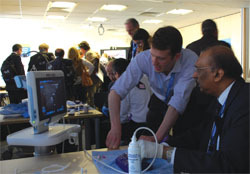
For the fourth year running, the Charing Cross Office Based Veins Course offered a vast selection of the latest therapies to treat varicose veins in an office environment. Over two sessions, 300 participants were trained on steam thermotherapy, mechano-chemo ablation, foam sclerotherapy, thread vein treatment and endovenous ablation, among other techniques.

Although the course is becoming larger it has retained its key features of small groups and one-on-one teaching with a strong emphasis on hands-on practice. CX Daily News asked Ian Franklin course director (London, UK) about the nature of the course and its evolution. “We started this course four years ago and at that time, this was the first veins course specifically aimed at looking at office-based techniques. We try to include many techniques as we possibly can and do not try to tell people what is the right or wrong way of doing things. We just offer them all the techniques and they come along and make up their own minds based on what suits their practice best,” he said. 

This year, the course has moved to more spacious surroundings. This is the “largest practical office-based vein practice course in the world,” said Franklin. “We have more space, so people are not pressured for time when learning their skills. We  also have a number of new techniques that we did not have before, so people can have the updates on the latest techniques available.” Another addition to this year’s course was the incorporation of mini symposia on essentials of setting up a successful private vein practice and also case-based discussions demonstrating the effectiveness of office-based techniques, Franklin added. 
Sherf Sholkamy, a surgeon from Cairo, Egypt, attended the course for the second year and has noticed how the course has helped him to evolve in treating thread and flare veins. “From this course, you get really good experience on how to do it and you just go home and do it,” he said. “I came a year ago to learn on the treatment of thread and flare veins and came back this year to resolve further questions, after practicing what I have learnt,” he added.  
 
As well as attendees, physicians teaching the techniques have seen the course has evolved. Ravi Singh Ranger, who was teaching venous closure for the treatment of varicose veins commented, “When I first started doing this course three years ago, these were new techniques and doctors were more interested in whether they worked or not, and if they worked how they got about doing them. What I find today is that the whole pendulum has shifted and doctors are now not questioning the validity of the techniques. They have done this before and all they want to know is what I would do if I had a really big vein, or how I manage a tortuous vein. They want to learn how to treat it perfectly.”
 
Lowell Kabnick, New York, USA, said, “Each year, the course seems to expand the amount of materials that are covered. The physicians that are passing through have more interest, more and more knowledge and so this faculty has been able to accommodate this. The hands-on models are also getting better, they are more sophisticated.This is my third year participating on this course and every year it gets much better…this is the best hands-on course and I have been to many of them.” He told CX Daily News, this is a place where physicians can come to learn about venous disease and they get it all, both from a didactic perspective and a hands-on one.”