


CX 2026 Registration
CX Executive Board
CX 2026 Programme
CX 2026 – The 48th Charing Cross Symposium
The Charing Cross (CX) Symposium continues to set the standard in vascular and endovascular education, shaping the future of practice worldwide. CX 2026 marked the final chapter of our current three-year cycle, designed to spark debate on the biggest controversies in the field. Our distinguished faculty of global experts critically examined the evidence, exchanged perspectives, and worked towards building consensus on the issues that matter most.
Consensus was the defining theme for CX 2026. We welcomed an international community of specialists, educators, and innovators to tackle the pressing challenges in vascular and endovascular medicine—challenges that directly impact patient outcomes and clinical decision-making.
In 2024, CX found a new home at ExCeL London, unlocking fresh opportunities for immersive, hands-on learning. The expanded workshop programme has gone from strength to strength, offering delegates practical skills alongside groundbreaking evidence and innovation. In 2026, we returned once again to London’s premier conference and exhibition venue to deliver an agenda packed with cutting-edge science, expert debate, and future-shaping education.
Stay connected—sign up for the CX Newsletter and be the first to hear the latest updates.
CX Co-Chairs

Latest CX news
Controversies back in the limelight at CX34
The Charing Cross International Symposium (London, UK, 14–17 April 2012) returns this year beginning another three-year cycle of themes: Controversies, Challenges and Consensus. This year’s CX promises high-profile debates between leading vascular and endovascular specialists. The programme also includes several educational opportunities, latest clinical trial data and industry-sponsored symposia.
The Vascular News Charing Cross Special Edition highlights some of the controversial topics which will take centrestage at CX34.
The future of TASC
The first Trans-Atlantic Inter-Society Consensus Document on Management of Peripheral Arterial Disease (TASC) was published in 2000 to provide an international consensus on the diagnosis and treatment of peripheral arterial disease. With the aim of continuing to reach a readership of vascular specialists, but also physicians in primary healthcare, TASC II was published in 2007. TASC IIb was intended to be a technical update set to elaborate on the role of endovascular techniques in relation to surgery, and to include guidance on more severe lesions than those covered in TASC II, but was never published.
Many physicians are interested either in understanding why TASC IIb did not emerge after much discussion between disciplines and key societies, or listening to issues being discussed now as TASC III approaches. There are various questions to address: Will anatomical classification stay fixed and treatments then be seen to be becoming more endovascular each time? Why was TASC initiated and what is it possible to achieve with the classification? What were the aims of TASC IIb and what can be expected of TASC III?
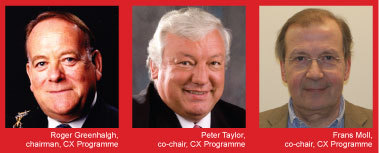
Roger Greenhalgh, chairman, CX Programme and editor-in-chief of Vascular News said: “Some key authors of TASC III will speak and the audience will better understand the issues, have their say and even vote on issues. This will be a type of huge, open, focus group. This will be in no way official, nor threatening, but the discussion could be very helpful for TASC III authors. If anatomy is to change repeatedly to fit mode of treatment, is this a turf war in disguise?”
Aneurysm screening
The prevalence of abdominal aortic aneurysm and aneurysm rupture has decreased in recent years as a result of reduced exposure to risk factors, mainly smoking. How is this affecting aneurysm screening programmes? In a session on aortic screening, CX delegates will hear about screening experiences from the UK, Sweden and Australia and their progress.
Which TEVAR technique?
One of the most pressing topics in thoracic intervention is whether the varying types of pathologies require specific devices. “A common view is that some endovascular devices are more suitable for some pathologies than others,” Greenhalgh said.
In a debate, Peter Taylor, London, UK, will try to convince delegates that thoracic aortic pathology is key to choice of treatment. Dittmar Boeckler, Heidelberg, Germany, will attempt to convince the audience to stick to a favourite device whatever the pathology.
Faculty members will also try to answer which technique is the first choice for each pathology, including total surgical repair; total endovascular repair with branched grafts, with off-the-shelf pre-loaded fenestrated grafts and with physician-made fenestrated grafts; hybrid repair; sandwich repair; and chimney repair.
Multilayer stent
Is the multilayer stent (MARS) approach a breakthrough or not? Michel Henry, Nancy, France, Charles McCollum, Manchester, UK, and Thomas Larzon, Orebro, Sweden, will present their experiences with the device. A discussion involving the panel and delegates will take place after the talks. “We need to hear hard outcome data on this to either take up this approach, or not. We approach it with an open mind,” Greenhalgh said.
Is CCSVI an entity?
This year, a session will be dedicated to discussions around chronic cerebrospinal venous insufficiency on Tuesday 17 April. Three years ago, Paolo Zamboni sparked controversy with the presentation of results indicating that patients with multiple sclerosis benefited from endovenous treatment.
“Chronic cerebrospinal venous insufficiency is very controversial. It is not yet clear if it is an entity or not or how often internal jugular venous stenosis is found without symptoms. If it is an entity, then correction of the venous stenosis provides a possibility of improving the condition in many patients,” Greenhalgh said.
“Is chronic cerebrospinal venous insufficiency a real phenomenon? We all need to know the answer to this because if it is, patients will benefit. Doctors and patients need to know as soon as possible either to call for more of these procedures or to stop doing them altogether,” he added.
The Great Debate “CCSVI: It is an entity and a subset of multiple sclerosis” will see Zamboni and Manish Mehta speaking for the motion, and Alun Davies and Richard Nicholas arguing against the motion. After the debate, the four presentations will focus on the main questions about CCSVI, followed by a discussion with the audience.
CX34 delegates will also see several debates on other topics in vascular and endovascular intervention such as drug-elution, the CREST trial and venous disease.
Study investigates whether a SWIFT transport system improves outcomes of ruptured aneurysm repair
A clinical study involving all vascular centres in Switzerland treating leaking aneurysms will try to answer whether the time from diagnosis to intervention is related to operative death from ruptured abdominal aortic aneurysms.
The details of the SWIFT (Swiss ruptured aneurysm favourable transport) study were presented at the CX@LINC symposium in Leipzig in January by Regula von Allmen, Vascular Research Group, Imperial College London, UK.
In 2010, according to the Swiss National Vascular Registry, which included data from 21 of 25 Swiss centres, there were 109 ruptured aneurysm repairs and 611 elective aneurysm repairs in Switzerland. In the registry report, 30-day mortality for ruptured aneurysm was 23.8% in Switzerland. In the UK, for example, the Hospital Episode Statistics show operative mortality rates up to 46% for ruptured abdominal aortic aneurysms, Von Allmen noted. “Why is there an interest in Switzerland? Some excellent results have been reported in this country. Switzerland is a circumscribed country and the centres performing vascular surgery are clearly identified,” she said.
She told delegates that there are great variations between centres in the country. “Reports from Zurich show that 50.2% of the ruptured aneurysm patients are managed by endovascular means and 49.8% by open repair. Zurich reports excellent results for EVAR with a 30-day mortality rate of 13.5%. Open repair has a mortality rate of 32.4%. But if patients look anatomically unsuitable for EVAR, then this may not be a fair comparison between open and endovascular repair. However, when we look at data from Bern, there are only 4% who are treated by endovascular means and the vast majority, 96%, is treated with open repair, and the overall 30-day mortality is 15.3%.
“From this we can see that there are pockets of excellence in the treatment of ruptured abdominal aortic aneurysm in Switzerland. As a consequence, it is claimed by one centre that it is unethical to carry out treatment other than EVAR for ruptured aneurysms, but there are obvious counterclaims for open repair based upon the data from Bern. However, the point is we cannot assume that the surgical method alone holds the key. That is why we feel that there is a need for the SWIFT study, including all the Swiss vascular centres,” she added.
SWIFT will be a prospective, all inclusive, study to be conducted for two years. The hypothesis is that the time from first clinical diagnosis of suspected rupture to the time of beginning the intervention relates to 30-day procedural mortality.
The primary endpoint is 30-day surgical mortality; however, rates for death during transfer and turn down rates with reasons for this will also be reported. Key additional factors are the condition of the patient on arrival at hospital, anatomical features assessed by CT scans, and type of transport.
“So why are Swiss results so good? Is it surgical skills? Is it the method? Is it patient selection? Could it relate to swift transfer?” Von Allmen questioned. “Being a circumscribed country, Switzerland has excellent transport facilities with good roads and helicopter use. For instance, cardiologists have proved that results of treatment of acute coronary episodes improved when the time from diagnosis to catheterisation was reduced, the so-called door-to-balloon time. Can it be the same for ruptured abdominal aortic aneurysms? With the participation of all 25 Swiss centres, we may be able to answer this question.”
Von Allmen will give the talk "The time from diagnosis to the operating suite:SWIFT" at the Charing Cross Symposium on 15 April, London, UK.
St George’s Valve Technology course now part of the CX Symposium
For the first time, the St George’s Valve Technology Symposium—now in its seventh year—will be an integral part of the Charing Cross International Symposium. Now called the CX St George’s Valve Technology Symposium, the event will take place during the first two days of the 34th CX Symposium (14–17 April 2012, Imperial College London, UK). Its theme, in keeping with the CX Symposium’s this year’s overall theme of “Controversies”, is “Valve Technology Controversies” in percutaneous valve techniques.
The first day of the symposium (Saturday 14 April) will focus on managing thoracic aorta diseases and will include talks on preventing paraplegia in aortic surgery and the endovascular management of acute type B dissection. The second day (Sunday 15 April) will review the management of valvular heart disease. The programme complements the thoracic day (Monday 16 April) of CX.
Marjan Jahangiri, professor of Cardiac Surgery, St George’s Hospital, University of London, UK, and programme director of the CX St George’s Valve Technology Symposium, told Cardiovascular News that there would also be a series of debates and case presentations during the two-day event. She added: “As the techniques are now more effective, this is a very good opportunity to discuss controversies around new modalities for the treatment of valve disease.”
The main discussion will happen around the topics surgery vs. transcatheter aortic valve implantation, minimally invasive surgery vs. transcatheter approach and the different techniques of percutaneous intervention. Mitral and tricuspid valve intervention will also be addressed.
According to Jahangiri, the programme is aimed at interventional cardiologists, cardiac and cardiothoracic surgeons, cardiac theatre and cath lab nurses and technicians, cardiac anaesthestists, and intensive care specialists. She explained that there would be opportunities for all delegates, especially trainees, to try some of the new technologies on mannequins.
Each year, the CX Symposium attracts more than 3,000 delegates from 75 countries. For more information on registering to attend the symposium, which is Europe’s longest running vascular symposium, and the CX St George’s Valve Technology Symposium, visit: www.cxsymposium.com