


CX NEWS
CREST fails to give carotid stenting a boost at CX
Ninety three per cent of the delegates attending the carotid sessions yesterday voted “no” to the question “CREST is telling us to swing towards carotid stenting, Should we?” at the great debate. The results of the voting gave Michael Jenkins and Michel Makaroun clear victory over Sumaira Macdonald and William Gray Sumaira Macdonald, Newcastle upon Tyne, UK, said that CREST was one of the largest contemporary randomised trials of carotid artery stenting versus carotid endarterectomy in standard risk patients.
“It forms part of the ‘big four’ representing the current evidence base for carotid intervention in ‘standard risk’ patients the remaining trials being EVA3S, SPACE, and ICSS,” she noted. “Whilst all are important in terms of current world knowledge, a number of process issues have arguably limited the generalisability of the other three. These ‘issues’ include failure to mandate the use of embolic protection devices and adequate baseline experience in the carotid artery stenting limb of the European trials, suboptimal myocardial infarction surveillance and myocardial infarction adjudication and for EVA3S and SPACE, and early termination.” Macdonald stated that CREST was exemplary by comparison: “The use of embolic protection devices was mandatory, the interventionists were properly trained, the incidence of periprocedural myocardial infarction was carefully screened and this outcome stringently adjudicated. It ran to completion. It is perhaps one of the more robust bodies of evidence, therefore and as a result, plays an important role in the provision of recommendations,” she said.
Siding with Macdonald, William Gray, New York, USA, told delegates that the CREST data clearly tells us to “swing” toward stenting as a reasonable alternative to endarterectomy. He noted that in CREST there are important findings beyond the primary endpoint. “There were slightly more minor strokes in the stenting group and slightly more myocardial infarctions in the endarterectomy group. The long-term consequences of these two disparities had distinctly different implications: by six months, the neurological status of both endarterectomy and stenting patients with minor stroke had equalised, and there was no mortality differential. At four years, one in four patients who sustained a myocardial infarction of any magnitude had died, as compared to an incidence of one in 10 deaths among the patients who did not have an event, a statistically significant difference,” Gray said.
He added that the age differential that was first published in the New England Journal of Medicine based on the intention-to-treat analysis and suggested that there was an advantage to endarterectomy over the age of 80 “was actually incorrect, as shown by the per-protocol analysis performed by the FDA in its assessment of the data”. “In point of fact the hazard ratio of the two techniques was not different (1.01) over the age of 80, and actually only showed a significant difference under the age of 60 with an advantage going to stenting in that age group,” he noted.
Gray also said that, although CREST included both symptomatic and asymptomatic patients, subsequent pre-planned analysis showed no differences for the primary outcome regardless of the symptom status. “There were non-primary outcome ‘nuisance’ events favouring stenting. There were no cranial nerve injuries in the stenting group, and over 5% in the endarterectomy group, more than 2% of which persisted at six months and almost of which involved a motor deficit. There was an approximately 8x greater incidence of access site complication for endarterectomy,” he said. “Based on these facts and analyses the unbiased observer, but more importantly the well-informed physician, cannot exclude stenting performed by an experienced operator using embolic protection in a well-selected patient as a reasonable, and in some instances, preferable as less invasive, therapy for patients requiring carotid intervention,” Gray said.
He added that “since there has been a decade-long controversy regarding the place of carotid artery stenting, with the vascular surgical specialty community largely opposed to the concept and practice, it is now fair to state that CREST causes us to ‘swing’ away from this nihilistic approach and toward parity between the two therapies. Used in such a complimentary fashion, we have the opportunity to provide the lowest risk alternatives to our patients, who are the ultimate beneficiaries of our ‘swing’.”
CREST has been misinterpreted
Representing Frank J Veith, New York, USA, who was not able to make CX 34, Michael Jenkins, London, UK, said that as a randomised controlled trial, CREST was in many ways “exemplary”. However, he added, like most randomised controlled trials, CREST had flaws and weaknesses. “It can also be argued that CREST results have been somewhat misinterpreted by its authors to reach unjustified conclusions. More importantly, CREST results have has been further misinterpreted or ‘spun’ by others to produce conclusions that are unjustified by the data from the trial,” Jenkins said. For example, he continued, CREST formed the basis for an important part of the American Heart Association Guideline on Management of Patients With Extracranial Carotid and Vertebral Artery Disease, which was also approved by 13 other organisations. “This important guideline document reached one conclusion that ‘carotid artery stenting is indicated as an alternative to carotid endarterectomy for symptomatic patients at average or low risk of complications associated with endovascular intervention…’”
Jenkins argued that CREST was originally designed to compare stenting and endarterectomy for the treatment of moderate and high grade carotid stenosis in recently symptomatic (six months) patients. However, he said, a large number of asymptomatic patients (1,180) were also included beginning in 2005. He criticised the inclusion of myocardial infarction in the primary endpoint. “There were substantially more deaths and strokes in the stenting treated patients than those treated by endarterectomy. Only when myocardial infarctions were included were the adverse events similar in the two groups,” he said. “CREST had several additional flaws. Adding asymptomatic patients to the study diluted its power and prevented significance from being reached in some of the adverse events. The composite endpoint weakened the trial. Myocardial infarctions are not the equivalent of strokes. This is borne out by the greater degree of disability after a stroke than a myocardial infarction. There is another possible flaw in CREST. The stenting treated patients received more intensive antiplatelet therapy during and after their procedure than did the carotid endarterectomy patients,” he added.
Jenkins also noted that in CREST “the stenting operators were only vetted to entre patients after they were shown to have a high level of experience and skill. Thus the stenting results in CREST may not be representative of those generally performing the procedure in the ‘real world’. This possibility is supported by the higher adverse event rates with stenting in all reported population based studies than in CREST.”
“What about the American Heart Association Guideline and its conclusion, largely based on CREST, that “carotid artery stenting is an alternative to carotid endarterectomy” in symptomatic average and low risk patients? A Webster’s dictionary definition of alternative is “choice between two things”. This implies equivalence. In view of the described considerations about CREST, its data details and the ICSS findings, it would seem that the American Heart Association Guideline’s conclusion that stenting is an alternative to endarterectomy is not yet justified except when there are clear contraindications to endarterectomy in a symptomatic carotid stenosis patient requiring invasive treatment. High or long lesions or infected, scarred or immobile necks represent examples of such contraindications.”
Agreeing with Jenkins, Michel Makaroun, Pittsburgh, USA, quipped whether Macdonald and Gray were “swinging for CREST or swinging for cash”.
He added that the CREST primary endpoint is flawed because it is a composite that combines periprocedural myocardial infarction with stroke and death. “CREST demonstrated that myocardial infarction has almost no bearing on patient quality of life, while both minor and major stroke clearly affect multiple quality of life domains. Without myocardial infarction, the CREST clearly demonstrates endarterectomy to be superior to stenting. Patients who suffer periprocedural myocardial infarction are indeed at a higher risk of post-operative death, but the CREST investigators clearly state that there is no cause-and-effect relationship, as the myocardial infarction is likely just a marker for more severe concomitant cardiac disease.”
In CREST, Makaroun continued, asymptomatic cardiac ischaemia was included as an endpoint, but asymptomatic neurologic events were not. “Data from ICSS suggests that nearly three times as many stenting patients as endarterectomy patients have new MR imaging lesions post-procedurally,” he said. “The CREST periprocedural results are very good, but the applicability of the stenting results to a wider population outside of the study is questionable. CREST appears to be telling us that symptomatic patients, older patients, and women are better served with endarterectomy. This leaves asymptomatic, younger male patients as having equivalent outcomes with stenting and endarterectomy. These young patients are probably not well served by a new technology with limited long term follow-up. CREST is telling us many things, but it is decidedly not telling us to swing towards carotid stenting.”
AJAX confirms no difference between EVAR and open repair for ruptured aneurysms
On Sunday evening, CX 34 delegates heard the results of the world’s first multicentre, randomised, controlled trial that compared EVAR and open repair for ruptured abdominal aortic aneurysms. The Dutch AJAX trial results demonstrated no difference between EVAR and open repair in emergent cases. In the same session, the audience also heard an outline of the SWIFT study on the effect of transport on ruptured aneurysm treatment outcomes. While AJAX results shed some light on treatment for ruptured aneurysms, many questions still remain unanswered
Ron Balm, Amsterdam, The Netherlands, presented the AJAX results, and Regula von Allmen, London, UK, presented on the SWIFT study (Swiss ruptured aneurysm favourable transport), which investigates whether the time from diagnosis to intervention relate to operative death of ruptured abdominal aortic aneurysm.
“Some excellent results have been reported in Switzerland which is a circumscribed country where the centres performing vascular surgery are clearly identified,” she said. Von Allmen told delegates that there are great variations between centres in the country. “Reports from Zurich show that 50% of the ruptured aneurysm patients are managed by endovascular means and 50% by open repair. Zurich reports excellent results for EVAR with a 30-day mortality rate of 13.5%; open repair has a mortality rate of 32.4%. But if patients look anatomically unsuitable for EVAR, then this may not be a fair comparison between open and endovascular repair.
“However, when we look at data from Bern, there are only 4% who are treated by endovascular means and the vast majority, 96%, is treated with open repair, and the overall 30-day mortality is 15.3%. “From this we can see that there are pockets of excellence in the treatment of ruptured abdominal aortic aneurysm in Switzerland. As a consequence, it is claimed by one centre that it is unethical to carry out treatment other than EVAR for ruptured aneurysms, but there are obvious counter claims for open repair based on the data from Bern. Disparities in views often point to uncertainty and there is no proof that surgical approach is the key,” she said.
Close on the heels of this presentation came the results of AJAX, which showed that indeed there was no difference between EVAR and open repair in the treatment of ruptured abdominal aortic aneurysms. The primary endpoint of AJAX was combined death and severe complications at 30 days. Our hypothesis was that EVAR would do better than open repair with endpoint rate of 0.40 and 0.65 for open repair, β=0.20, α=0.05 in a sample size of 112 patients. Secondary endpoints were length of hospital and intensive care unit stay, intubation/ventilation and use of blood products.
“The trial area covered 1.2 million inhabitants and three trial centres and seven regional hospitals contributed data. All patients with ruptured aneurysms in the trial area were identified and followed,” said Balm. He told delegates that the preferred EVAR technique was use of an aorto-uni-iliac graft with contralateral occluder and femorofemoral crossover bypass. “Between April 2004 and February 2011, 520 patients with ruptured abdominal aortic aneurysms were enrolled in the trial and 90% (466) were enrolled in a trial centre.”
Three hundred and ninety five patients were evaluated with CTA, and 240 were found to have unfavourable anatomy for EVAR. Thirty nine patients were excluded, of these 16 were unfit for open repair, 11 were excluded for logistical reasons, seven for haemodynamic instability following CT, and five patients refused surgery. Balm said, “116 patients were randomised: 57 to EVAR and 59 to open repair. The results showed that in terms of the primary endpoint EVAR had a combined and severe complications rate of 42% (24/57) at 30 days. In the open repair group, this rate was 47% (28/59), (ARR 5.4% [95% CI -13 to +23]). These results showed, said, Balm, that the hypothesis that EVAR is better than open repair, could not be confirmed.
With regard to the secondary endpoints, ICU stay with open repair was 48 hours while it was 28 hours with EVAR (p=0.14); hospital stay was nine days with EVAR and 13 days with open repair (p=0.57); 39 patients had to use a mechanical ventilator with EVAR while 52 did so with open repair (p=0.002). Balm said, “Blood loss with EVAR was 500 ml while it was 3500 ml with open repair (p<0.001). Forty five EVAR patients needed blood during the surgery while 56 patients did so after open repair (p=0.01).
“EVAR performed a little better on the secondary endpoints,” Balm said. He told CX delegates that death with EVAR was 21% (12/57) while with open repair it was 25% (15/59). “Was there a selection of haemodynamically stable patients, asked Balm, noting that 17% of the entire cohort was haemodynamically unstable (78/466). In the randomised controlled portion, 20% was haemodynamically unstable (23/116).” Additionally, he also posed the question of whether the triallists had selecting simple anatomy, by drawing attention to the death rate following open surgery in patients with unfavourable anatomy, which was 26% in the cohort (58/222). The 30-day death rate of all consecutive patients who underwent surgery was 30% (138/454) (95% CI 26–35%).
Balm cited data from Visser P et al that was published in EJVES in 2005. The population-based analysis showed a 41% in-hospital operative mortality in The Netherlands (95% CI 40–42%) Importantly, said Balm, ‘all comers’ were consecutively enrolled in the analysis that this was a major strength of this study.
In conclusion, Balm said, “With AJAX trial results showing that EVAR vs open repair was ARR 5.4% (95% CI -11 to +23), we saw that open repair performed much better than expected with low death rates in the randomised controlled trial, but also low death rates in the entire cohort.” He said, “This could be attributable to the introduction of the trial with optimised logistics and patient care such as the pre-operative CTA and centralisation.”
Live from CX 34: Tack-IT endovascular stapler wins New Technology Dragons’ Den award
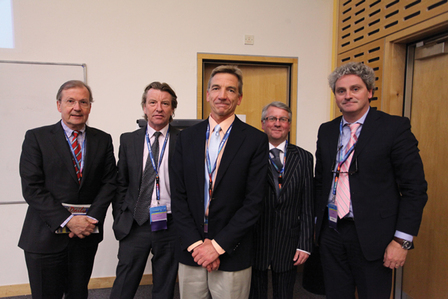
First-time Dragons’ Den winner Peter Schneider (Honolulu, USA) beat off stiff competition with his recently CE-marked device the Tack-IT endovascular stapler, which is designed to optimise peripheral angioplasty results for the treatment of peripheral artery disease.
The other contenders were Ralf Kolvenbach, Düsseldorf, Germany, with the BYFix Anastomic device (HDH Medical), which is used to mechanically connect any standard vascular graft to the blood vessel; Claude Mialhe, Draguignan, France, with the Twister device - a new concept of endovascular embolisation and occlusion; and James Coleman (Dublin, London) with a novel percutaneous transapical closure device for structured heart disease and aortic arch procedures.
Schneider said that the acute technical success with the endostapler device “was good”, the ability to place the device “right where we wanted it” was 96% in their first-in-man series, and procedure time was similar to a standard lower extremity case. He added: “We got the acute stent-like result without a stent while addressing some of disadvantages of stent.”
External aortic wall diameter in screening is preferred, CX delegates believe
In the first debate of Sunday’s CX, the majority of delegates (71%) agreed with the motion that “we prefer external aortic wall diameters in screening”
Naghmana Riazuddin, Wycombe, UK, who was speaking for the motion, said that the inner wall of the aorta was difficult to see and that the external wall was “much clearer”.
To support her arguments, Riazuddin outlined the findings of the UK Small Aneurysm Trial, which showed that the “outer to outer” method of measuring aortic diameter (in abdominal aortic aneurysms) could be used without any problems. She added that there is approximately 3mm of difference between inner-to-inner measurements and outer-to-outer measurements.
She said, therefore, if a patient was found with an aortic diameter of 2.9cm, by using the inner-to-inner method, they could actually have a diameter of 3.2cm. Riazuddin explained that this could have implications for treatment. She said: “A 4.7cm aorta via an inner-to-inner method would not be referred for vascular surgery, but it would be 5cm via an outer-to-outer method.” The threshold for intervention is 5cm. Concluding, she said that the outer-to-outer method was traditionally used and most of the trial data was based on this method. She explained that in a poll of 41 centres across Europe, 32 said that they used the outer-to-outer method. She added: “Aortas scanned by others outside of the [UK National] screening programme are still using outer-to-outer, so will we have different actual measurements for the 5.5cm threshold?”
Arguing against the motion was Tim Hartshorne (Leicester, UK). He outlined the benefits of the inner-to-inner method. He said a study, of which he was the lead author, found that (as Riazuddin argued) there was the expected difference between the inner-to-inner method and the outer-to-outer method in terms of diameter, but it also showed that there was better accuracy and reliability with the inner-to-inner method.
He said: “This is important in the context of National Screening Programmes to assure consistency between technicians and surveillance visits.” Countering Riazuddin’s argument that the outer-to-outer method should be used because the 5cm threshold is based on trials that used that method, he said: “The inner-to-inner method should be used given that that there is evidence of better reproducibility but it would be possible to adjust referral thresholds if it was found that there was an increased rupture rate in men under surveillance, for instance from 5.5cm to 5.2cm (inner-to-inner method).”
He added: “Screening programmes including the NHS abdominal Aortic Aneurysm Screening Programme will gather large amounts of data on the natural history of aortic aneurysms, providing information and evidence that may lead to modification and improvement of the present schedules.”
After the debate, Roger Greenhalgh, Imperial College, London, CX programme chairman, and chair of the first aortic session, also posed the question: “Is it crazy that we ever adopted a variety of ultrasound borders for determining aortic diameter for infrarenal aortic abdominal aneurysms? The delegates overwhelmingly voted “yes” , with only 17% saying “no”.
CX delegates give a standing ovation to Nicholay Vodolos
As Nicholay Volodos, who developed a self-fixing synthetic endoprosthesis in the former Soviet Union in 1984, was unable to make CX 34, Krassi Ivancev, London, UK, spoke about the early history of endovascular repair on his behalf. Commenting on Volodos’ work, Ivancev said he was the “pioneer who started the endovascular stent graft revolution.”
Roger Greenhalgh, London, UK and CX programme chairman, also praised the work of Volodos and asked people to stand if they thought it was worthwhile sending a message, via Ukranian delegates, to Volodos about how much everyone appreciated Volodos’ achievements – the entire audience stood up to celebrate his work. Volodos used the self-fixing synthetic endoprosthesis to perform his first transfemoral remote endosprothesis implantation in an iliac artery. This was in May 1985.
Two years later, he performed an endovascular repair for an aneurysm in the descending section of the thoracic aorta. “The world’s first EVAR was performed in 1987 by professor Nicholay Volodos in Kharkov, Soviet Union, and introduced in an article written in 1988,” Ivancev said at CX.
The first EVAR procedure reported in the literature took place on 7 September 1990, when Juan Parodi, Julio Palmaz and HD Barone at the Instituto Cardiovascular de Buenos Aires, Argentina, treated an abdominal aortic aneurysm patient. The aneurysm was excluded endoluminally with a Dacron graft that was anchored at the proximal infrarenal neck with a stainless steel balloon-expandable stent. Ivancev said, “Volodos realised the mechanical properties required of a stent graft. He designed, manufactured and implemented the first stent graft and his principles are still valid and exploited by us today.”
Volodos’ early experience was recorded in a paper titled “Experience with endovascular stent grafts for arterial disease from 1985 to present”, which was presented at the 21st Annual Symposium on Current Critical Problems – New Horizons and Techniques in Vascular Surgery in 1994. He wrote: “Trying to realise more effectively Charles Dotter’s attractive idea of implanting a prosthesis in not easily approached vessels through a superficially lying vessel, we developed a self-fixing synthetic endoprosthesis in 1984. This endoprosthesis received the national patent of the former USSR on 22 May 1984. At that initial stage we called the method a remote endoprosthesis.” “The design feature of the endoprosthesis was a fixing element in the form of a radial zigzag shaped cylindrical spring. The spring was made from stainless steel wire 0.4–0.5mm in the diameter.
The height of the fixing element was about 18mm. As a rule, the number of rings was six or seven,” Volodos reported. The first animal studies with the endoprosthesis were conducted in dogs, with the transfemoral prosthesis implanted in the thoracic aorta. “The results of the study showed good function of the endoprosthesis six months after the operation,” Volodos said.
Volodos and colleagues used these results as the basis to perform endoprosthesis implantation in patients. “The first operation of transfemoral remote endoprosthesis implantation in the iliac artery in the clinic was performed on 4 May 1985.
It was done in combination with a simultaneous femorotibial bypass,” he wrote. In the first report, Volodos said that 19 patients had been treated for stenosis and occlusions of the iliac arteries. “Positive results were achieved in 17 patients immediately after operation and in 15 patients in the late period (from one to eight years).” “Transfemoral remote endoprosthesis implantation with the self-fixing synthetic endoprosthesis in case of the traumatic aneurysm of the descending section of the thoracic aorta was performed on 24 March 1987. It was performed in four patients, with positive results in all of them. At 7.5 years of follow-up, it has shown good function of the endoprosthesis.” After that, Volodos performed endoprosthesis implantation of the abdominal aorta in five patients – two of them received a bifurcated synthetic endoprosthesis. “The accumulated experience with the self-fixing synthetic endoprosthesis permits us to consider that remote endoprosthetics should have a place in the treatment of patients with lesions of the aorta and main arteries,” Volodos concluded in the paper.
Gene linked to abdominal aortic aneurysm is found
Matt Bown, Leicester, UK, led an international team of investigators which identified a single gene that is linked to the development of abdominal aortic aneurysm. During the discussion session, after the results were presented, the point was made that the interaction between the gene LRP1 and environmental factors was key.
Bown told CX delegates on Sunday that the investigators carried out a genome-wide association discovery study of 1,866 patients with abdominal aortic aneurysm and 5,435 controls and replication of promising signals (lead single-nucleotide polymorphism [SNP] with a p value <1×10⁻⁵) in 2,871 additional cases and 32,687 controls and performed further follow-up in 1,491 abdominal aortic aneurysms and 11,060 controls. “In the discovery study, nine loci demonstrated association with abdominal aortic aneurysms (p<1×10⁻⁵). In the replication sample, the lead SNP at one of these loci, rs1466535, located within intron 1 of low-density-lipoprotein receptor-related protein 1 (LRP1) demonstrated significant association (p=0.0042),” Bown said. “We confirmed the association of rs1466535 and abdominal aortic aneurysm in our follow-up study (p=0.035).
In a combined analysis (6,228 abdominal aortic aneurysms and 49,182 controls), rs1466535 had a consistent effect size and direction in all sample sets. No associations were seen for either rs1466535 or the 12q13.3 locus in independent association studies of coronary artery disease, blood pressure, diabetes, or hyperlipidaemia, suggesting that this locus is specific to abdominal aortic aneurysms. “Our findings suggest a mechanism contributing to abdominal aortic aneurysm formation via the LRP1 pathway, and exploration of this mechanism could provide future therapeutic approaches to preventing the development and/or progression of abdominal aortic aneurysms,” Bown et al reported.
“This study identifies a biological process that could be altered using drugs and therefore treat aneurysms, either to prevent them completely or to prevent them growing,” Bown said. “The key challenges are to identify how the protein produced by this gene causes or protects against aneurysms and then work out ways to reduce or increase the activity of the protein or pathway that this protein is involved in. The next step is to find out how the protein produced by this gene is involved in the development of aneurysms,” he noted.
He concluded that the gene was aortic aneurysm specific and that it was biologically plausible. In the discussion after his study was presented, Martin Bjorck, Uppsala, Sweden, asked Bown about the possible interaction between the LRP1 gene and environmental factors. Bown said their data was limited and not powered to detect such an interaction. Janet Powell, London, UK, commented: “The reason why we white people get aneurysms must partly be because of our environment and partly because of our genes.”
The research, funded by The Wellcome Trust, was published in The American Journal of Human Genetics in November 2011.